Ownership
Three-pin EV charging: extension leads and a hot plug
Two UK owner questions answered: what to do when the cable will not reach, and when heat or tripping means stop.
A longer lead or a lower current setting is not proof that a three-pin charging arrangement is safe. Two recurring UK owner questions concern a cable that will not reach and a plug that becomes hot. Start with the equipment instructions and the installation, not a forum’s chosen amp setting.
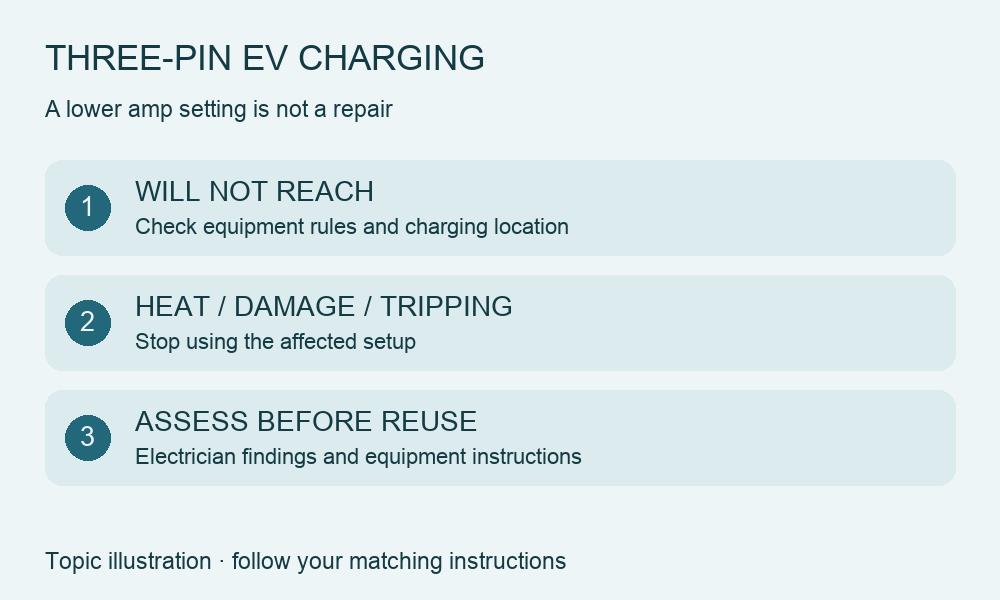
1. Can I add an extension because the charging cable will not reach?
Read the portable charger’s instructions first. If extensions, adaptors or smart plugs are prohibited, do not add one. A 13A label or outdoor rating alone does not approve the complete EV charging arrangement. Never daisy-chain leads or use a domestic multi-socket extension for EV charging.
Electrical Safety First’s current EV advice favours a dedicated chargepoint and explains that prolonged EV load can exceed an ordinary socket/wiring arrangement’s design. It identifies dedicated-circuit EV sockets marked BS1363/EV. Have a competent electrician assess the actual circuit and intended load; swapping a faceplate yourself is not that assessment.
If the approved equipment cannot reach, use a suitable public/destination chargepoint while arranging a compliant charging location. Ask the installer to specify the required position, circuit/protection and equipment compatibility in writing. Permission for land or cable routing is separate; a neighbour accepting the cable does not establish permission for a pavement crossing.
2. The plug is hot or the circuit trips. Can I just reduce the amps?
Do not treat reduced current, a replacement fuse or a smart plug as a repair for heat, damage or repeated tripping. End charging using the equipment’s normal stop procedure. Isolate power only if safe; do not handle a hot, scorched or wet connection. For smoke/fire, keep clear and use emergency assistance.
Electrical Safety First lists hot-plastic smells, scorching, melting, crackling and repeated tripping as danger signs. Keep the affected setup out of use until an electrician and, where appropriate, the charger manufacturer have checked the relevant parts. Do not remove a socket, tighten terminals or repeatedly reset a breaker to continue charging.
Give them the charger make/model, current setting, outlet/circuit used, any extension/adaptor, session duration and exactly where heat or damage appeared. Take photographs only after isolation and when safe. Ask what failed, what was tested and whether the final arrangement is suitable for prolonged EV charging. An apparently cool test for a few minutes is not proof that an overnight session is safe.
Next: plan a public-charging fallback · check whether home-chargepoint support applies to you.
Real UK question leads: extension to reach a socket and heat/damage during three-pin charging. Their electrical and insurance claims are not adopted as fact. No universal insurer-coverage claim or DIY wiring specification. Evidence checked 18 October 2026.
PRACTICAL NEXT STEP · EVDeal
Turn the answer into a decision.
Applies to: UK portable three-pin EV charging; equipment instructions and a competent assessment of the actual circuit determine suitability.
Evidence checked · Review due
Review is due. Recheck the primary source and your exact version before relying on changing details.
First useful check
Check charger instructions and the complete socket/lead arrangement before use; stop a hot, damaged or repeatedly tripping setup.
Read the result
A cable reach problem needs a compliant charging location; reducing amps does not prove a heat/tripping defect has been repaired.
Stop or change approach: Do not handle hot/wet damaged connections, open sockets or reset breakers repeatedly; keep damaged equipment out of use.
Prepare a useful record
Charger model/current, circuit/outlet, extensions or adaptors, duration, location of heat/damage and electrician findings.
Keep registration, VIN, account numbers and personal addresses out of this note. Nothing typed here is sent to us or saved automatically. Copy it before leaving the page.
Evidence and answer standard
Documented checks and diagnostic distinctions; owner reports identify concerns, not universal repairs. The date records an evidence review, not a physical test of your car. A forum report can identify a question; it cannot establish a universal repair.
How EVDeal checks owner guidance →Did this guide move you forward?
Count a helpful answer or flag a gap. This is editorial feedback, not a repair diagnosis or a request for a personal reply.
What this sends
Only this guide ID, revision, selected category and vote are counted. No notes, name, search text or IP address are stored in the feedback database. Standard hosting logs still apply. Counts are votes, not unique owners or verified faults.
Savings paths
Related EV savings categories
Explore practical guides and information for charging, accessories and other EV ownership costs.
Continue exploring
More useful EV guides
 Ownership
Replacing an EV windscreen? Confirm the camera calibration and cover
18 Oct 2026 Read guide → Ownership
EV brake replacement quote? Ask for the evidence first
17 Oct 2026 Read guide → Buying Guide
Discussion
Comments
Comments are manually reviewed before publication to keep EVDeal useful and spam-free.