Ownership
Replacing an EV windscreen? Confirm the camera calibration and cover
A practical UK checklist for glass approval, calibration evidence and unresolved driver-assistance warnings after a replacement.
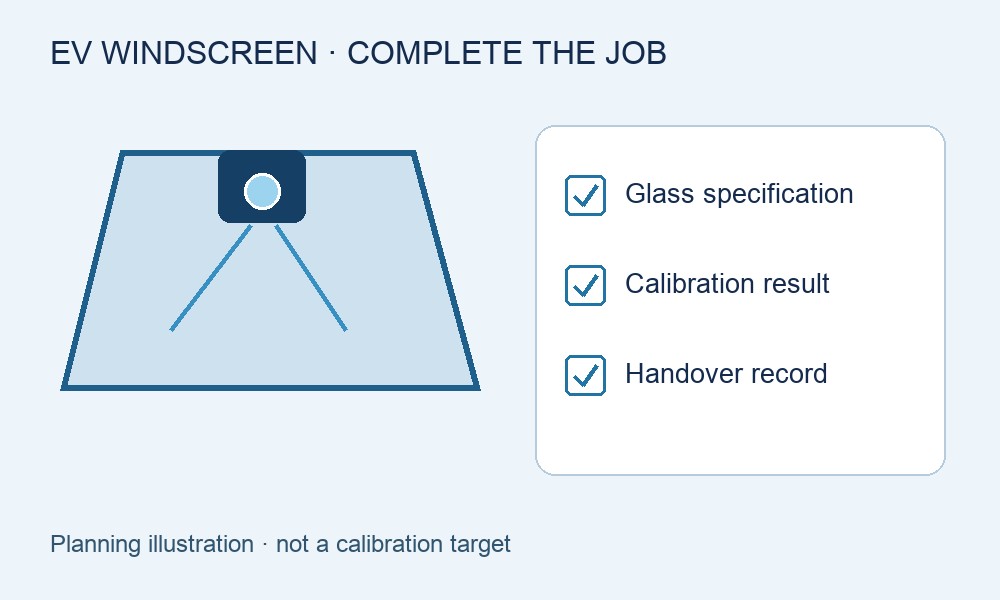
Before authorising the job, get two answers: who has approved the glass and costs, and who will complete the manufacturer-required camera calibration for your exact car. A fitted windscreen and a cleared warning message are different evidence from a completed calibration.
1. Confirm cover before booking outside the approved route
Open your own policy schedule and glass section. Write down the excess, any separate repair/replacement limit, approved repairer route and what needs prior authorisation. Do not assume every comprehensive policy, third-party policy or independently booked job has the same cover. Ask the insurer or authorised claim handler to confirm in writing the proposed glass specification, calibration cost, any separate specialist visit and what you must pay. If manufacturer-branded glass is important, obtain approval rather than assuming it will be funded.
If there is no glass cover, request an itemised self-pay quote that includes the required calibration or names who will do it and at what agreed cost. Do not compare a glass-only price with a complete replacement-and-calibration price.
2. Identify the car and the repair capability
Give the repairer the exact model, year and fitted camera/heated-screen/head-up-display equipment so the correct screen can be identified. Supply registration/VIN privately through its legitimate booking route when needed, not in public comments. Ask whether it can carry out the manufacturer’s procedure on that exact version. EV propulsion alone does not identify the glass or calibration method.
Autoglass explains that camera position can change when glass is replaced. A static calibration uses workshop equipment; a dynamic procedure involves driving. The manufacturer’s repair method determines the job. Do not ask to skip a required calibration because the camera was not unplugged or the dash looks normal.
3. Agree what completion evidence you will receive
Thatcham Research’s ADAS repair position calls for the fitted systems to be identified, the relevant repair method followed and auditable calibration results retained. Its record checklist includes vehicle identity, date, repairer/technician and equipment. Ask for a copy showing the affected system, outcome and any limitations or unfinished work, alongside the glass invoice/job sheet. A scan that merely clears fault codes does not, by itself, show a required calibration succeeded.
At handover, check the paperwork relates to your car and this visit. Ask the repairer to explain any failed/incomplete result and its safe-release advice. Retain the authorised quote, completion record and aftercare instructions together.
4. Warnings remain, or calibration could not be completed
Record the exact warning and when it appeared; do not deliberately provoke lane-departure or emergency-braking intervention to test it. Contact the repairer and insurer/claim handler with the job reference and ask who will arrange and authorise the outstanding diagnosis/calibration. If the provider lacks support for your version, require an agreed specialist route before paying for a second attempt. Keep a dated record of the response.
If visibility, steering or safe control is affected, stop safely and arrange assistance. Otherwise obtain explicit professional advice about whether the car may be driven and which assistance functions are unavailable; do not rely on those systems pending resolution. Do not enter service menus, move the camera or attempt a home calibration.
One Financial Ombudsman decision involved uncertainty over whether the correct calibration software had been used after a windscreen replacement. It illustrates why the actual result and repair capability matter; it is an individual decision, not a promise that another claim has the same remedy.
Copy this booking question: “Please confirm the approved glass, my total contribution, the manufacturer-required calibration for my exact car, who performs it, the completion record supplied, and the agreed route if it cannot be completed.”
Next: check repair and vehicle documents when buying used · understand static and dynamic calibration before booking.
Prompted by UK owner questions about replacement providers and calibration, including this UK post-replacement discussion. Forum experiences do not establish your cover or the cause of a warning. Evidence checked 18 October 2026; prices and individual policy terms are deliberately not generalised.
PRACTICAL NEXT STEP · EVDeal
Turn the answer into a decision.
Applies to: UK EV windscreen repair planning; exact manufacturer procedure, fitted ADAS and individual insurance contract determine the job and cover.
Evidence checked · Review due
Review is due. Recheck the primary source and your exact version before relying on changing details.
First useful check
Before authorising work, obtain written glass/cost approval and confirmation of who can perform and document calibration for the exact car.
Read the result
A complete quote and successful relevant calibration record resolve different questions; missing support or incomplete results need an agreed specialist route.
Stop or change approach: Do not move cameras, attempt home calibration or deliberately trigger safety systems. Stop safely for impaired visibility or control and seek assistance.
Prepare a useful record
Approved quote and claim/job reference, glass specification, calibration system/date/outcome, limitations, exact warning and repairer response.
Keep registration, VIN, account numbers and personal addresses out of this note. Nothing typed here is sent to us or saved automatically. Copy it before leaving the page.
Evidence and answer standard
Primary repair guidance and evidence checklist; individual policy terms and vehicle methods must be confirmed. The date records an evidence review, not a physical test of your car. A forum report can identify a question; it cannot establish a universal repair.
How EVDeal checks owner guidance →Did this guide move you forward?
Count a helpful answer or flag a gap. This is editorial feedback, not a repair diagnosis or a request for a personal reply.
What this sends
Only this guide ID, revision, selected category and vote are counted. No notes, name, search text or IP address are stored in the feedback database. Standard hosting logs still apply. Counts are votes, not unique owners or verified faults.
Savings paths
Related EV savings categories
Explore practical guides and information for charging, accessories and other EV ownership costs.
Continue exploring
More useful EV guides
 Ownership
Three-pin EV charging: extension leads and a hot plug
18 Oct 2026 Read guide → Ownership
EV brake replacement quote? Ask for the evidence first
17 Oct 2026 Read guide → Buying Guide
Discussion
Comments
Comments are manually reviewed before publication to keep EVDeal useful and spam-free.